Beyond the Backbone: Why European Aerospace Needs Vision and Fascination to Win the War for Talent and the Race to the Future
When astronauts look down at Earth, they experience the “Overview Effect” – a vantage point where borders are invisible and the planet appears as a single, boundless entity. In our current industrial landscape, the lines between aviation and space are similarly dissolving into a unified domain: Aerospace. However, while the aviation industry masterfully navigates its post-pandemic recovery, the European space sector remains in the “launch phase” of its commercial narrative. To lead the global market, Europe must pair its world-class engineering with a bold vision and the radical fascination required to win the global Space Race 2.0.
The Inflection Point: Learning from History
The World Economic Forum (WEF) indicates that the space industry has reached an inflection point similar to the early days of the internet. Historically, technologies like the radio or the automobile moved from niche novelties to ubiquitous essentials once they found market fit. “Could space technologies be next?“
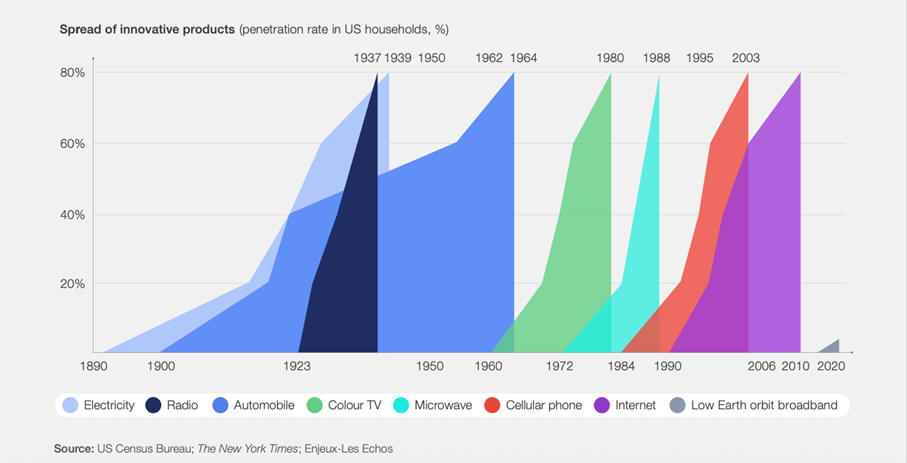
This pattern is visible in Figure 1 of the WEF report, which tracks the penetration of life-changing innovations. Current market data highlights this acceleration:
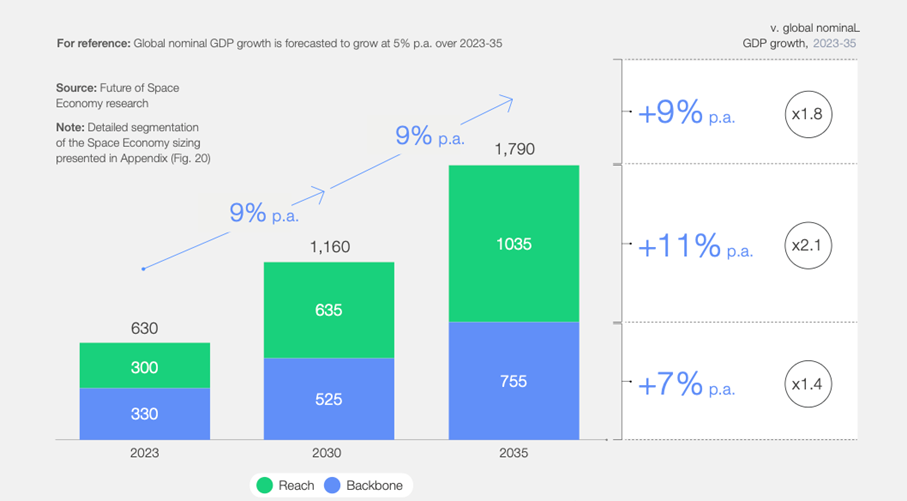
The total space economy is projected to grow from $630 billion in 2023 to $1.79 trillion by 2035. With an annual growth rate of 9%, this sector is significantly outperforming the projected global nominal GDP growth of 5%, representing a total market increase of 1.8x
Mastering the ‘Reach’
A fundamental transformation is occurring as the industry shifts its focus toward impact and connectivity. While the technical “Backbone” (infrastructure and hardware) is growing at 7% per annum (a 1.4x increase), the application layer – the “Reach” – is surging at 11% per year. By 2035, this Reach sector, which connects orbital technology to life on Earth, will have expanded by a factor of 2.1. For European aerospace, technical excellence alone is no longer enough; we must translate these technical milestones into a compelling vision to attract capital and talent.
Winning the War for Talent
Despite our technological brilliance, Europe remains a “silent giant”. This “narrative deficit” creates a critical threat: a drain of capital and talent toward competitors like SpaceX, who captivate the world with a vision of making humanity “multi-planetary”. To win the war for talent, we must bridge the “Fascination Gap”. Generation Z is drawn to industries with a shared vision and a clear purpose. We must communicate our pioneering spirit – such as the green transition and autonomous flight – with radical confidence to show young professionals they are taking a seat in the cockpit of Europe’s future.
Conclusion: A Mission, Not a Task
To secure Europe’s economic potential, we must transform our “Science Fiction” into scalable business cases. This requires moving away from “zero-mistake” cultures that stifle creativity and creating “Safe Spaces” for messy, iterative innovation. If we want to win the race to the future, we must stop giving young talent tasks and start giving them a mission. The sky is no longer the limit; it is merely the starting line.
References
World Economic Forum. (2024). Space: The $1.8 Trillion Opportunity for Global Economic Growth. McKinsey & Company.